Planning Chardham Yatra in 2026 and not sure if the roads are open, blocked, or safe? You are asking exactly the right question — because on Himalayan pilgrimage routes, road status is not just a travel update; it is a safety concern. The Chardham Yatra road status changes rapidly, especially between June and August when cloudbursts and landslides are nearly routine. Getting this wrong can mean being stranded at Joshimath for three days, or worse.
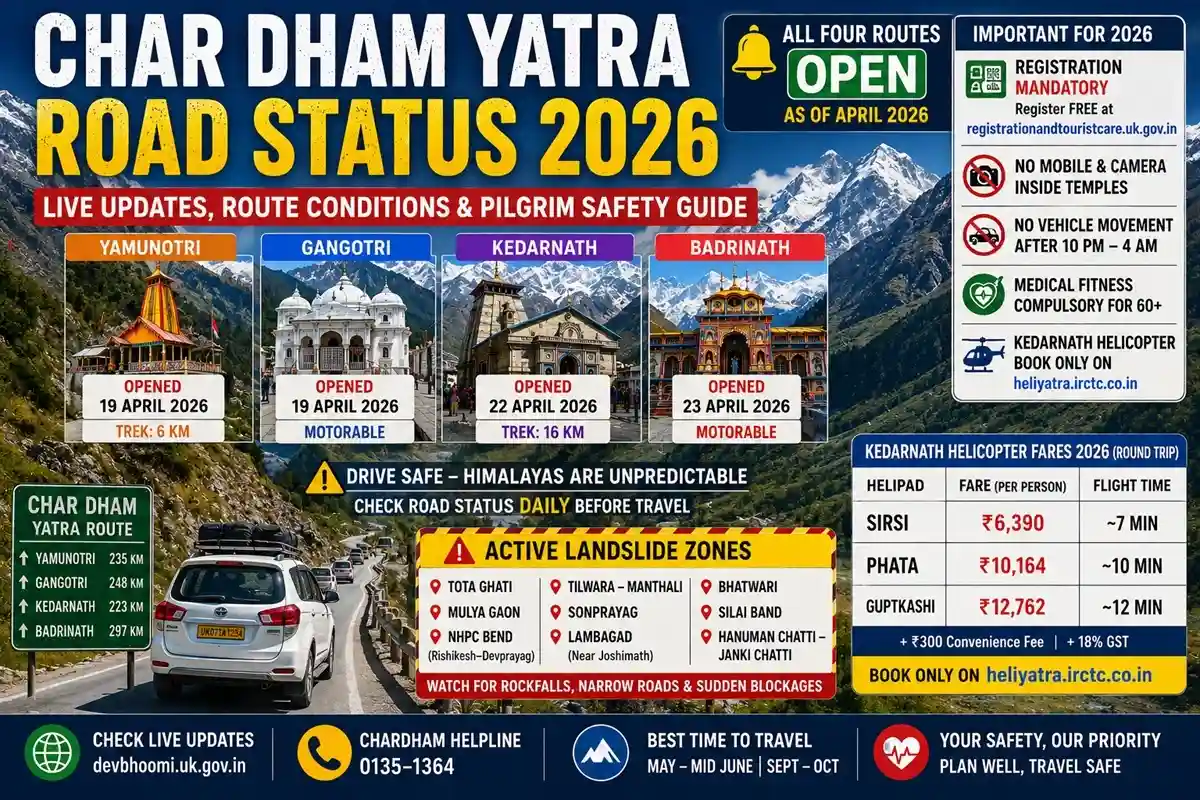
The 2026 Chardham Yatra season has officially opened, with Yamunotri and Gangotri welcoming pilgrims from 19 April, Kedarnath from 22 April, and Badrinath from 23 April. All four routes are currently open as of the season start. But as every experienced yatri knows, ‘open’ in the Himalayas means ‘open today’ — and that can change by tomorrow morning after a cloudburst.
This guide gives you a verified, 2026-accurate breakdown of each Chardham highway segment, known danger zones, real registration steps, current helicopter prices, and everything else you need to make this yatra safe and smooth.
Key Takeaways — 2026 Chardham Yatra Season
- Confirmed 2026 opening dates: Yamunotri & Gangotri — 19 April | Kedarnath — 22 April | Badrinath — 23 April
- Tentative closing dates: Gangotri 10 Nov | Yamunotri 11 Nov | Kedarnath 11 Nov | Badrinath ~13 Nov 2026
- Chardham Yatra registration is mandatory for all four dhams — register FREE at registrationandtouristcare.uk.gov.in
- Registration portal opened 6 March 2026; 60% slots online, 40% offline at counters
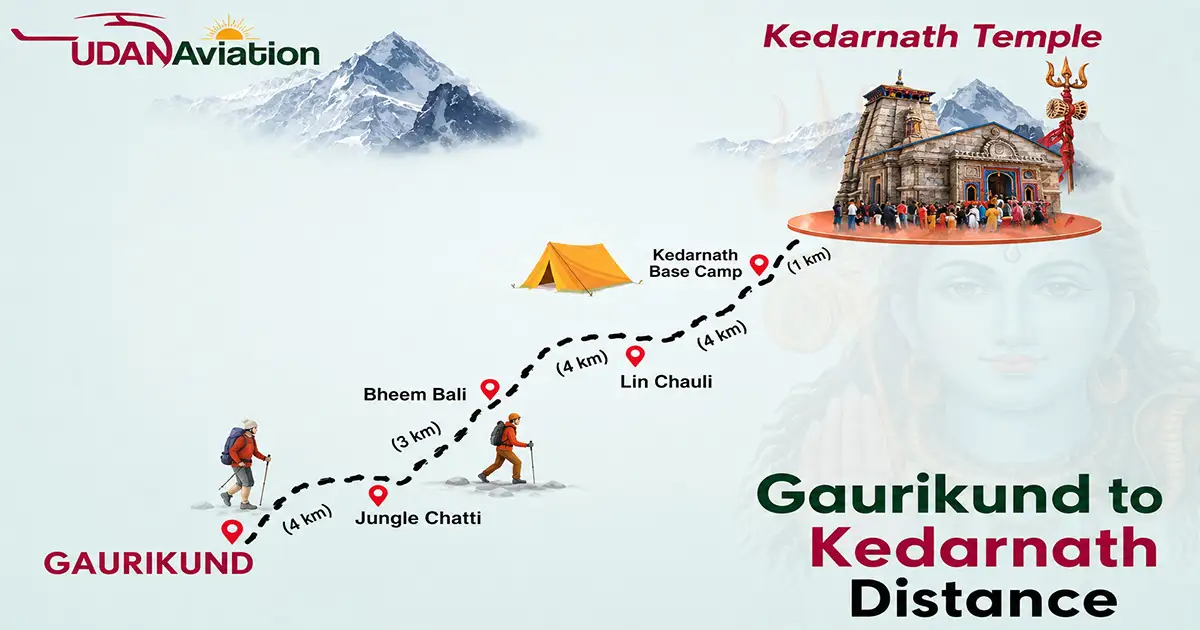
- Kedarnath trek: 16 km on foot from Gaurikund; motorable road ends at Sonprayag/Gaurikund (~223 km from Rishikesh)
- Helicopter booking ONLY via official IRCTC portal heliyatra.irctc.co.in — beware of fraud agents
- Best travel months: May–mid June and September–October; avoid July–August (peak monsoon)
- Over 30 active landslide zones flagged on Rishikesh–Devprayag stretch as of April 2026; drive with caution
Chardham 2026 Official Opening & Closing Dates
| Dham | 2026 Opening Date | Opening Occasion | Tentative Closing Date |
| Yamunotri | 19 April 2026 | Akshaya Tritiya | 11 November 2026 |
| Gangotri | 19 April 2026 | Akshaya Tritiya | 10 November 2026 (Diwali) |
| Kedarnath | 22 April 2026 | Announced on Maha Shivratri | 11 November 2026 (Bhai Dooj) |
| Badrinath | 23 April 2026 | Announced by BKTC | ~13 November 2026 |
Opening dates are decided based on the Hindu Panchang calendar. Kedarnath’s date is traditionally announced on Maha Shivratri, while Yamunotri and Gangotri open on Akshaya Tritiya. Badrinath’s date is declared by the Badrinath-Kedarnath Temple Committee (BKTC). These are now confirmed for 2026.
Chardham Yatra 2026 Route Status: Segment-by-Segment
Most pilgrims start from Haridwar or Rishikesh. From there, four arterial highways connect to the four dhams. Here is the ground-level status for each as of the 2026 season.
Route 1: Rishikesh to Badrinath — NH-7 (Rishikesh–Badrinath Highway)
Distance from Rishikesh: approximately 297 km | Drive time: 10–12 hours under normal conditions
This is the most-used and longest Chardham highway. The route goes through Devprayag, Srinagar (Garhwal), Rudraprayag, Chamoli, Joshimath, and finally Badrinath. The road is mostly two-lane but narrows significantly near Vishnuprayag and in the last stretch toward Mana village near Badrinath.
A critical warning specific to 2026: Reports from April 2026 flagged over 30 active landslide zones on the Rishikesh–Devprayag stretch alone. Areas around Tota Ghati, Mulya Gaon, and NHPC Bend are particularly vulnerable. Debris and narrowed road widths have been reported. Local drivers usually recommend passing these sections before 8 AM, when traffic is lighter and rocks haven’t heated enough to loosen.
- Key caution zones: Tota Ghati, Mulya Gaon, NHPC Bend (Rishikesh–Devprayag), Lambagad (Pipalkoti–Joshimath), Vishnuprayag bridge
- Road type: Two-lane NH-7; single-lane patches near Helang bypass and Mana village
- Alternate route available: Delhi–Kotdwar–Pauri–Srinagar (Garhwal) or Delhi–Rishikesh–Gaja–Devprayag
Route 2: Rishikesh to Kedarnath — Via Rudraprayag & Gaurikund
Distance from Rishikesh to Gaurikund: approximately 223 km | Drive time: 7–8 hours normally
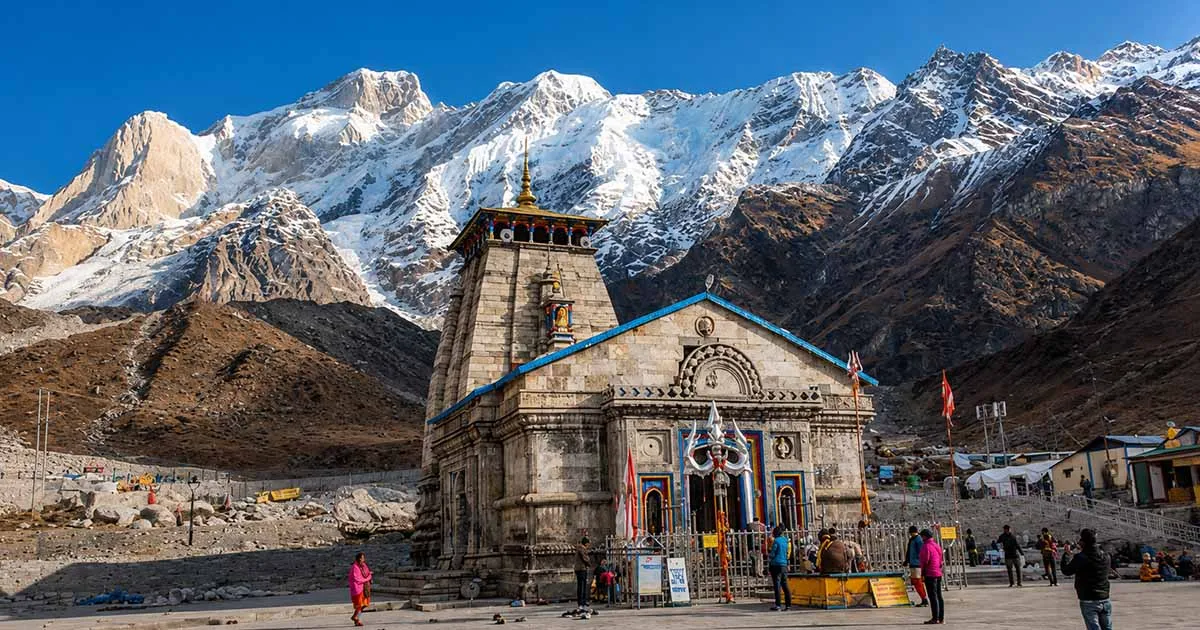
The motorable road for Kedarnath ends at Gaurikund (1,984 m altitude). From there, a 16 km one-way trek leads to Kedarnath temple (3,583 m). The route passes through Haridwar, Devprayag, Rudraprayag, Agastmuni, Tilwara, Guptkashi, Sonprayag, and Gaurikund.
Entry to Sonprayag and beyond requires a valid yatra registration QR code (E-Pass). The Sonprayag barrier is a strict checkpoint — without a registered E-Pass, you will not be allowed through, regardless of road conditions. During peak May weeks, the daily pilgrim cap means arriving at Sonprayag before 6 AM is strongly advised.
- Road ends at: Gaurikund — 16 km trek from here to Kedarnath temple
- Key caution zones: Tilwara–Manthali stretch, Sonprayag bridge, Mandakini river crossings post-rainfall
- Helicopter operates from: Phata, Guptkashi, Sirsi helipads — book via heliyatra.irctc.co.in only
Route 3: Rishikesh to Gangotri — Via Uttarkashi
Distance from Rishikesh: approximately 248 km | Drive time: 8–9 hours normally
The Gangotri highway runs via Rishikesh–Chamba–Uttarkashi–Harsil–Gangotri. This is generally the quietest of the four Chardham routes in terms of traffic density, which makes it comparatively smoother. The road is reasonably maintained until Uttarkashi.
The 25 km stretch from Harsil to Gangotri becomes tricky during rain. The 2026 season has flagged Bhatwari (between Uttarkashi and Harsil) as a zone where road blocks occurred during the early season. Post-monsoon, landslide debris near Dharali and Bhaironghati can narrow the highway significantly.
- Key caution zones: Bhatwari, Harsil–Gangotri stretch, Dharali, Bhaironghati
- Gangotri town itself: Motorable road ends here; the glacier trek beyond is a separate adventure
Route 4: Rishikesh to Yamunotri — Via Barkot & Janki Chatti
Distance from Rishikesh: approximately 235 km | Drive time: 8–9 hours normally
The Yamunotri route goes via Rishikesh–Chamba–Barkot–Janki Chatti. The trek to Yamunotri temple begins from Janki Chatti (6 km one-way). Some pilgrims use Phoolchatti as an alternative starting point — the trek is shorter but steeper.
What many first-timers don’t realize: the Mussoorie bypass via Naugaon adds 30–40 minutes but saves significant hairpin-bend stress compared to the Chamba–Barkot route, especially for those prone to motion sickness. Local transporters with experience on this route often recommend the bypass route if you have elderly passengers.
- Motorable road ends at: Janki Chatti — 6 km trek to Yamunotri
- Key caution zones: Hanuman Chatti–Janki Chatti stretch, Silai Band, Ojri, Banas areas
- Alternative trek start: Phoolchatti (shorter, steeper)
Chardham Yatra 2026 Distance & Route Chart
| Dham | From Rishikesh | Drive Time (Normal) | Trek Required | Max Altitude |
| Yamunotri | ~235 km | 8–9 hrs | 6 km (Janki Chatti) | 3,293 m |
| Gangotri | ~248 km | 8–9 hrs | None (motorable) | 3,048 m |
| Kedarnath | ~223 km to Gaurikund | 7–8 hrs | 16 km (Gaurikund) | 3,583 m |
| Badrinath | ~297 km | 10–12 hrs | None (motorable) | 3,133 m |
Chardham Yatra 2026 Registration: Step-by-Step Process
Chardham Yatra registration is mandatory for all four dhams in 2026. The Uttarakhand government opened the registration portal on 6 March 2026. Without a valid QR-coded E-Pass, you will be turned back at check posts — even if the highway is completely open.
Official Portal: registrationandtouristcare.uk.gov.in — Registration is 100% FREE. Do not pay any website or agent claiming to charge a fee. Beware of fraud portals that mimic the official design.
How to Register Online — Step by Step
- Visit registrationandtouristcare.uk.gov.in (official Uttarakhand government portal)
- Click ‘Register/Login’ — sign up with your mobile number and email ID
- Enter personal details: full name, Aadhaar number (mandatory), address, emergency contact
- Click ‘Create Tour’ — select your travel dates and the dhams you plan to visit
- Choose your mode of transport (vehicle type, bus, helicopter)
- Upload passport-size photo — this links to your QR-coded E-Pass
- Download and save the E-Pass (QR code) — carry both digital and printed copies
- Show the E-Pass QR code at each checkpoint (Rishikesh, Rudraprayag, Sonprayag, Joshimath, Pandukeshwar)
Other Registration Methods (Official)
- Mobile App: Download ‘Tourist Care Uttarakhand’ from Google Play Store or Apple App Store
- WhatsApp: Type ‘Yatra’ and send to +91-8394833833 — the bot guides you through registration
- Toll-Free Helpline: Call 0135-1364 for voice-assisted registration
- Offline Counters: Available at Haridwar, Rishikesh, Barkot (Yamunotri), Hina (Gangotri), Sonprayag (Kedarnath), Pandukeshwar (Badrinath)
Important for 2026: 60% of total daily slots are allocated for online registration and 40% for offline. Counters in Rishikesh (30 counters) and Haridwar (20 counters) will remain open 24/7 during the first 15 days of the season. An Aadhaar card is mandatory — other IDs are no longer sufficient as the primary document.
Kedarnath Helicopter Booking 2026 — Official Prices & Rules
For senior citizens, those with health conditions, or pilgrims short on time, helicopter services to Kedarnath are the most practical option. In 2026, IRCTC is the only authorized booking platform.
Official helicopter booking portal: heliyatra.irctc.co.in only. Eight aviation companies operate services including Pawan Hans, Himalayan Heli, Trans Bharat, Arrow Aviation, and others. Booking opened 15 April 2026 at 6 PM. Slots for Guptkashi and Phata helipads fill within 90 minutes on opening day.
2026 Kedarnath Helicopter Fare Table (UCADA-Regulated)
| Helipad | Round-Trip Fare (Per Person) | One-Way Fare | Flight Time | Remarks |
| Sirsi | ₹6,390 | ₹3,043 | ~7 minutes | Cheapest; hardest to book — books out first |
| Phata | ₹10,164 | ₹4,840 | ~10 minutes | Most popular; balanced price-availability |
| Guptkashi | ₹12,762 | ₹6,077 | ~12 minutes | Costliest; premium experience; more slots |
Note: Above fares are base fares per UCADA notification. IRCTC convenience fee of ₹300 and 18% GST are added at checkout. One-way tickets are not sold on the IRCTC portal — all bookings are return trips. Char Dham Yatra registration (E-Pass URN) must be linked at the time of helicopter booking.
From practical experience: if you miss the April 15 booking window, check the IRCTC portal every morning at 9–10 AM for cancellation slots. Cancellations from no-shows during bad weather days do become available.
Chardham Yatra 2026 — Month-wise Weather & Road Status
| Month | Weather | Road Condition | Crowd Level | Recommended? |
| April (late) | Cool; snow at high altitudes | Just opened — debris clearing ongoing | Low-moderate | Yes (quiet, scenic) |
| May | Pleasant; mild at lower altitudes | Open — BRO active; best road state | Very high | Excellent — book early |
| June (early–mid) | Warm; pre-monsoon showers | Open with increasing landslide watch | Peak | Good — watch forecasts |
| June (late)–August | Heavy monsoon | Frequent closures; landslide zones active | Low (risky) | Avoid if possible |
| September | Post-monsoon; clearing skies | Mostly open; some debris patches | Low-moderate | Very good — hidden gem |
| October | Cool; brilliant visibility | Open — roads at their clearest | Moderate | Ideal for families |
| November (early) | Cold; snowfall begins at high points | Routes closing progressively | Very low | Limited; check dates |
| Nov 10–13 | Winter closure | Dham temples close for season | Closed | No |
Transport Options for Chardham Yatra 2026
Private Taxi / SUV — Most Flexible
Most families and pilgrim groups prefer a private cab for the full Chardham circuit. An experienced local driver is genuinely invaluable — they know exactly which stretches to cross before sunrise, which dhabas to stop at, and how to navigate sudden road changes. Expect to pay Rs 22,000–35,000 for a complete circuit (10–12 days) from Haridwar/Rishikesh, depending on vehicle type and season.
Uttarakhand Transport Corporation (UTC) Buses — Budget Option
UTC and GMOU buses connect Rishikesh to Uttarkashi (Gangotri base), Rudraprayag/Guptkashi (Kedarnath base), Chamoli/Joshimath (Badrinath route), and Barkot (Yamunotri base). Fares are under Rs 500 per segment. Buses fill fast in May–June — arrive at the stand at least 1 hour early. Direct Delhi–Kedarnath bus service also runs via UTC.
Helicopter Services — For Senior Citizens & Time-Constrained Pilgrims
Helicopter services operate for Kedarnath from Phata, Guptkashi, and Sirsi. Book only via heliyatra.irctc.co.in. For Badrinath, charter helicopters are available from Jolly Grant Airport, Dehradun for luxury packages (Rs 1,40,000–2,35,000 per person for multi-dham aerial packages).
Best Time for Chardham Yatra 2026 by Road
Best time for Chardham Yatra by road: May to mid-June and September to October. May offers the freshest post-winter roads and manageable weather. September after the monsoon delivers arguably the most beautiful Himalayan landscapes — clear skies, lush green valleys, and far fewer crowds than peak season. October is ideal for a calm, unhurried yatra.
Avoid July–August. This is not a casual recommendation — it is based on what happens every single year. In July 2025, over 40 Kedarnath pilgrims were stranded near Sonprayag overnight after cloudbursts blocked the road. Roads to Gaurikund, Badrinath near Ummta, Gangotri at Bhatwari, and Yamunotri at Silai Band all blocked simultaneously. More than 100 rural roads across Uttarakhand were closed on a single day. This happens annually.
Road Safety & Travel Tips for Chardham Yatra 2026
Before You Leave — Check These Every Morning
- Uttarakhand Police Devbhoomi Traffic Portal: devbhoomi.uk.gov.in — real-time road status
- BRO (Border Roads Organisation) official X/Twitter: @BROindia — clearance announcements
- SDMA Uttarakhand: sdma.uk.gov.in — disaster and road block advisories
- Chardham helpline: 0135-1364 | Disaster Management: 1070 | Police: 100 | SDRF: 9411112985
On the Road — Non-Negotiable Rules
- Never drive at night on any Chardham route — accidents on these highways after dark are disproportionately fatal
- Never attempt to cross a blocked stretch or flooded river crossing — wait for BRO clearance
- Use a BIS-rated vehicle — overloaded or poorly maintained vehicles on mountain grades are a serious risk
- Carry extra food, water, and warm clothes — road blocks can mean an overnight wait at altitude
- Start each day’s drive before 6–7 AM — BRO clears roads early; afternoon brings rockfall risk
- Do not stop on landslide-prone stretches, even briefly — keep moving through risky sections
Altitude Awareness at the Four Dhams
Kedarnath sits at 3,583 m and Badrinath at 3,133 m. At these heights, even healthy adults can experience mild altitude sickness. Symptoms — persistent headache, nausea, breathlessness at rest — are a signal to descend, not push through. Spending one night at Joshimath (1,890 m) before continuing to Badrinath is strongly recommended, especially for first-time high-altitude travellers.
Chardham Yatra 2026 Tips for Senior Citizens
A medical fitness certificate is now required at registration for pilgrims above 60. This is not just a formality — the Himalayan terrain genuinely demands physical preparedness.
- Get a cardiologist’s clearance if you have BP, diabetes, or any cardiac condition
- Helicopter to Kedarnath is strongly recommended for those above 65 or with limited mobility
- Pony and palki (palanquin) services available at Kedarnath (Gaurikund) and Yamunotri (Janki Chatti) — book in advance
- Acclimatize at Joshimath (1,890 m) for Badrinath, at Barkot for Yamunotri
- Carry Diamox (acetazolamide) ONLY if prescribed — do not self-medicate
- Avoid Tapt Kund cold water dip at Badrinath if you have unstable blood pressure
- Keep a pulse oximeter — below 90% SpO2 at altitude requires descent
Fraud Warning — Fake Booking Sites & Helicopter Agents
Every year, the Chardham season brings a surge of fake websites and agents. In 2026, this problem is well-documented:
- Registration is 100% FREE — any website charging for it is a fraud
- Kedarnath helicopter tickets are booked ONLY via heliyatra.irctc.co.in — no agent is authorized
- Fake portals that mimic the official registration site have been reported — always check the URL carefully
- If a site promises ‘guaranteed’ or ‘VIP’ registration, it is a scam
- WhatsApp-based agents claiming to book helicopter slots outside IRCTC are frauds — report to cybercrime
Accommodation Along the 2026 Chardham Route
From practical experience on the ground: budget guesthouses in Barkot, Uttarkashi, Guptkashi, and Joshimath fill up by 3–4 PM during peak May–June season. If you are travelling without pre-booked accommodation, start hunting before 2 PM. GMVN (Garhwal Mandal Vikas Nigam) tourist rest houses offer government-maintained, reasonably priced rooms along the entire route.
| Location | Type Available | Approx. Cost/Night (2026) | Tip |
| Rishikesh / Haridwar | Budget to luxury hotels | ₹800 – ₹6,000 | Ideal base; all facilities |
| Barkot (Yamunotri base) | Budget guesthouses, dharamshalas | ₹600 – ₹2,500 | Book ahead — fills fast in May |
| Uttarkashi (Gangotri base) | Mid-range hotels, GMVN | ₹800 – ₹3,000 | Good food options available |
| Guptkashi / Rudraprayag | Budget to mid-range, GMVN | ₹700 – ₹2,500 | Kedarnath circuit base |
| Joshimath | Budget to mid-range, GMVN | ₹800 – ₹3,000 | Acclimatization stop; must book |
| Badrinath | GMVN, dharamshalas, budget | ₹600 – ₹3,500 | Very limited; book 2–3 weeks ahead |
Realistic Chardham Yatra 2026 Budget Breakdown
| Expense | Budget Option | Mid-Range | Comfortable / Premium |
| Transport (full circuit) | UTC Bus: ₹3,000–5,000 | Shared cab: ₹20,000–28,000 | Private SUV: ₹30,000–45,000 |
| Accommodation (10–12 nights) | ₹6,000–10,000 | ₹14,000–22,000 | ₹28,000–50,000 |
| Food (per day) | ₹250–400 | ₹450–700 | ₹800–1,500 |
| Registration & misc charges | ₹500–1,000 (free portal) | ₹1,000–2,000 | ₹2,000–5,000 |
| Kedarnath helicopter (if used) | N/A | ₹6,390–10,164 (Sirsi/Phata RT) | ₹12,762 (Guptkashi RT) + GST |
| Pony/palki (Kedarnath or Yamuno) | ₹1,500–2,500 one way | ₹2,500–4,000 | Palki: ₹5,000–8,000+ |
| TOTAL (10–12 day trip) | ~₹20,000–30,000 | ~₹45,000–65,000 | ~₹90,000–1,50,000+ |
Chardham Yatra Packing Checklist 2026
Non-Negotiable Documents
- Aadhaar Card (original + 2 photocopies) — mandatory for registration
- Chardham Yatra E-Pass / QR code (digital + printed copies)
- Medical fitness certificate (compulsory for pilgrims above 60)
- Helicopter ticket printout (if booked via IRCTC)
- Emergency contact card in wallet or bag
Clothing for Mountain Altitudes
- Thermal inner wear (3–4 sets) — essential even in May at Kedarnath/Badrinath
- Fleece jacket or woollen sweater (at least 2)
- Waterproof rain jacket / windcheater — non-negotiable for monsoon-adjacent months
- Trekking shoes with ankle support — for Kedarnath and Yamunotri treks
- Woollen socks (5–6 pairs), woollen cap, gloves
Health & Safety Essentials
- Pulse oximeter — monitor blood oxygen at altitude (below 90% SpO2: descend immediately)
- Personal prescription medicines with doctor’s prescription letter
- ORS sachets, glucose, energy bars for trek days
- First aid kit: bandages, antiseptic cream, paracetamol, antacids, motion sickness tablets
- Sunscreen SPF 50+, UV-protection sunglasses (high altitude UV is intense)
- Portable phone charger / power bank — charging points unreliable at higher altitudes
Common Mistakes That Ruin Chardham Yatra — Avoid These
- Not registering in advance: The Sonprayag barrier for Kedarnath will physically stop you without an E-Pass. Register at registrationandtouristcare.uk.gov.in before leaving home.
- Driving at night: Mountain fatalities on Chardham routes are heavily skewed toward night-time driving. The rule is simple: stop before dark.
- Ignoring early altitude sickness: Headache + breathlessness + nausea at altitude = warning signs. Many pilgrims push through hoping it passes. Some end up in AIIMS Rishikesh’s emergency ward.
- Booking helicopter through agents: Only heliyatra.irctc.co.in is authorized. Agents claiming to offer tickets outside this portal are frauds.
- Arriving at accommodation without a booking in peak season: Hotels in Badrinath and Barkot fill by early afternoon. Book 1–2 weeks ahead for May–June.
- Carrying one copy of the E-Pass only: Mobile network is poor or absent near Badrinath and Kedarnath. Always carry a printed backup.
- Overpacking for treks: The Kedarnath 16 km trek at 3,500 m altitude with a heavy bag is exhausting. Keep trek bags under 7 kg; use pony/porter for anything heavier.
How to Check Chardham Yatra Road Status Live in 2026
The fastest way to get accurate road status is not Google Maps — it is often hours behind in remote Himalayan areas. Use these sources in order of reliability:
- Uttarakhand Police Devbhoomi Portal: devbhoomi.uk.gov.in — official traffic updates
- BRO Twitter/X handle: @BROindia — posts road clearance and blockage updates in near real-time
- SDMA Uttarakhand: sdma.uk.gov.in — disaster and landslide advisories
- Helpline 0135-1364 — Uttarakhand’s dedicated Chardham Yatra helpline
- Local WhatsApp groups of drivers and hoteliers in Joshimath, Guptkashi, Uttarkashi — fastest ground intelligence
- Call your accommodation at the next destination — they have up-to-the-hour local information
Alternate Routes When Primary Chardham Roads Are Blocked
| Blocked Route | Primary Route | Alternate Route |
| Badrinath (NH-7 blocked near Devprayag) | Rishikesh → Devprayag → Joshimath → Badrinath | Delhi → Kotdwar → Pauri → Srinagar (Garhwal) → Rudraprayag → Badrinath |
| Badrinath (alternative 2) | NH-7 via Rishikesh | Rishikesh → Gaja → Devprayag → Chamoli → Badrinath |
| Kedarnath (Gaurikund blocked) | Rishikesh → Rudraprayag → Sonprayag | Consider Helicopter from Phata/Sirsi if road remains blocked |
| Gangotri (Bhatwari stretch) | Rishikesh → Uttarkashi → Gangotri | Wait for BRO clearance at Uttarkashi — no viable alternate |
Frequently Asked Questions — Chardham Yatra Road Status 2026
Q1. Are Chardham Yatra routes open in 2026?
Yes. All four Chardham routes opened as follows: Yamunotri and Gangotri on 19 April, Kedarnath on 22 April, and Badrinath on 23 April 2026. Routes are currently operational. However, landslide-prone sections on the Rishikesh–Devprayag stretch (Tota Ghati, Mulya Gaon, NHPC Bend) require caution. Check devbhoomi.uk.gov.in or call 1364 daily before departure.
Q2. What is the most dangerous stretch on the Chardham road in 2026?
In 2026, the Rishikesh–Devprayag stretch of NH-7 has over 30 active landslide zones flagged as of April, including Tota Ghati, Mulya Gaon, and NHPC Bend. Beyond Devprayag, the Lambagad–Joshimath section remains historically problematic. On the Kedarnath route, the Tilwara–Manthali stretch and Sonprayag area see regular blockages during monsoon.
Q3. Is Chardham Yatra registration mandatory for all four dhams?
Yes, registration is mandatory for all four dhams in 2026. The process is free and done at registrationandtouristcare.uk.gov.in. Registration opened 6 March 2026. An Aadhaar card is now the mandatory primary ID. You will receive a QR-coded E-Pass which is verified at all major check posts.
Q4. What are the 2026 Kedarnath helicopter prices?
UCADA-regulated round-trip fares for 2026: Sirsi — ₹6,390, Phata — ₹10,164, Guptkashi — ₹12,762 per person. IRCTC convenience fee (₹300) and 18% GST are added at checkout. Book ONLY via heliyatra.irctc.co.in. Bookings opened 15 April 2026. Sirsi and Phata slots sell out within hours on opening day.
Q5. Can I do Chardham Yatra in July or August 2026?
It is strongly not recommended. The Himalayan monsoon causes repeated road closures between late June and August every year without exception. In July 2025, roads to all four dhams were blocked simultaneously on a single day due to cloudbursts. If you must travel during this period, keep multiple buffer days, do not travel alone, and have a clear evacuation plan.
Q6. How do I check today’s Chardham road status?
Visit devbhoomi.uk.gov.in for official traffic updates, follow @BROindia on X (Twitter) for real-time clearance news, or call helpline 0135-1364. Your local driver or hotel at the next destination is often the fastest source of ground-level road intelligence.
Q7. What is the correct Chardham Yatra route sequence?
The traditional and recommended sequence follows a west-to-east direction: Haridwar/Rishikesh → Yamunotri → Gangotri → Kedarnath → Badrinath. This is considered the auspicious order and also makes logistical sense in terms of road connectivity. The complete circuit covers approximately 1,000–1,200 km by road from Haridwar/Rishikesh.
Q8. How long does it take to complete Chardham Yatra by road?
A comfortable, well-paced Chardham Yatra by road takes 10–14 days from Rishikesh/Haridwar. Rushing it in 8 days is possible but exhausting and not advisable for elderly pilgrims or families with children. Helicopter-assisted yatra can be completed in 5–6 days.
Q9. When do the Chardham temples close in 2026?
Tentative closing dates: Gangotri — 10 November (Diwali); Yamunotri — 11 November (Diwali); Kedarnath — 11 November (Bhai Dooj); Badrinath — approximately 13 November 2026. These dates are traditional and confirmed by the temple committees around Vijayadashami. Plan your return travel well before these dates to avoid the late-season rush.
Q10. Is Chardham Yatra safe for senior citizens travelling by road?
Yes, with the right preparation. Badrinath and Gangotri are fully motorable — no trekking required. Kedarnath offers pony, palki, and helicopter options from Gaurikund. Yamunotri has pony and palki from Janki Chatti. A medical fitness certificate is compulsory for registration if you are above 60. A cardiologist check-up before the trip is strongly recommended.
Q11. What happens if the road is blocked mid-journey?
Stay at the nearest safe town and wait for BRO clearance. For Badrinath blockages, stay at Joshimath. For Kedarnath, stay at Rudraprayag or Guptkashi. For Gangotri, stay at Uttarkashi. BRO typically clears minor blockages in 6–48 hours. Carry sufficient food, water, warm clothes, and cash — ATMs are scarce and unreliable at higher altitudes.
Q12. Can I drive my personal car on Chardham routes?
Yes, personal cars are permitted on all Chardham highway routes. A sturdy SUV or 4WD vehicle handles the terrain far better than sedans, especially on the Gaurikund approach and narrow stretches near Mana village (Badrinath). Ensure the vehicle is fully serviced before departure; carry a spare tyre, tow rope, and basic tools.
Q13. What is the Chardham Mahamarg (All-Weather Road) project status?
The Char Dham Pariyojana (All-Weather Road Project) — a national highway development project — is ongoing. Several stretches, including sections near Devprayag and Joshimath, have been widened. However, construction work itself can cause temporary delays and narrowed lanes on the highway. Account for 30–60 minutes of extra travel time if you encounter active construction zones.
Final Advice: Plan Smart, Verify Daily, Travel Safely
Chardham Yatra 2026 is fully open and underway. The confirmed opening dates, the mandatory registration system, fixed helicopter prices, and real-time road monitoring tools have made this yatra more organized than ever before. But the Himalayas remain unchanged — unpredictable, magnificent, and unforgiving of careless planning.
If you are travelling between May and mid-June, book accommodation and helicopter tickets (if needed) at least 3–4 weeks in advance. Guptkashi and Badrinath rooms fill fast. If you are travelling in September or October, you will find the roads quieter, the mountains cleaner, and the experience considerably more personal.
Senior citizens should seriously consider helicopter services for Kedarnath and plan one dedicated acclimatization day at Joshimath before ascending to Badrinath. Families with young children should keep a minimum two buffer days built into the itinerary for weather-related delays.
Check the road status every morning before departure. It takes five minutes and can save you a day stranded on a mountain highway. The correct portal is devbhoomi.uk.gov.in and the helpline is 0135-1364. Use them.