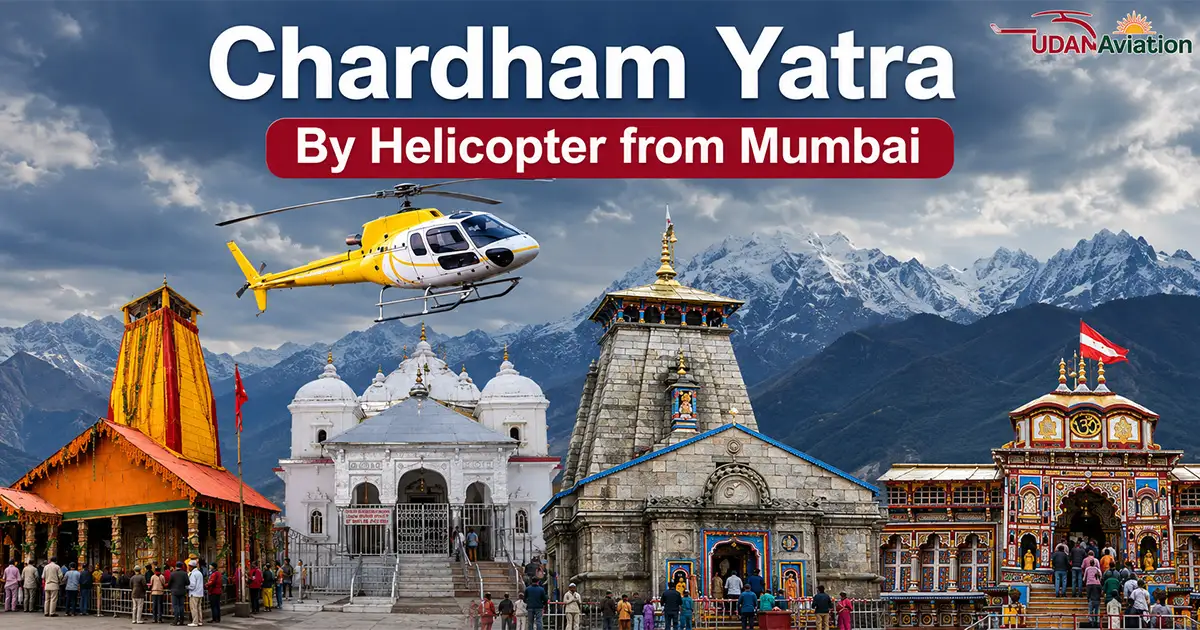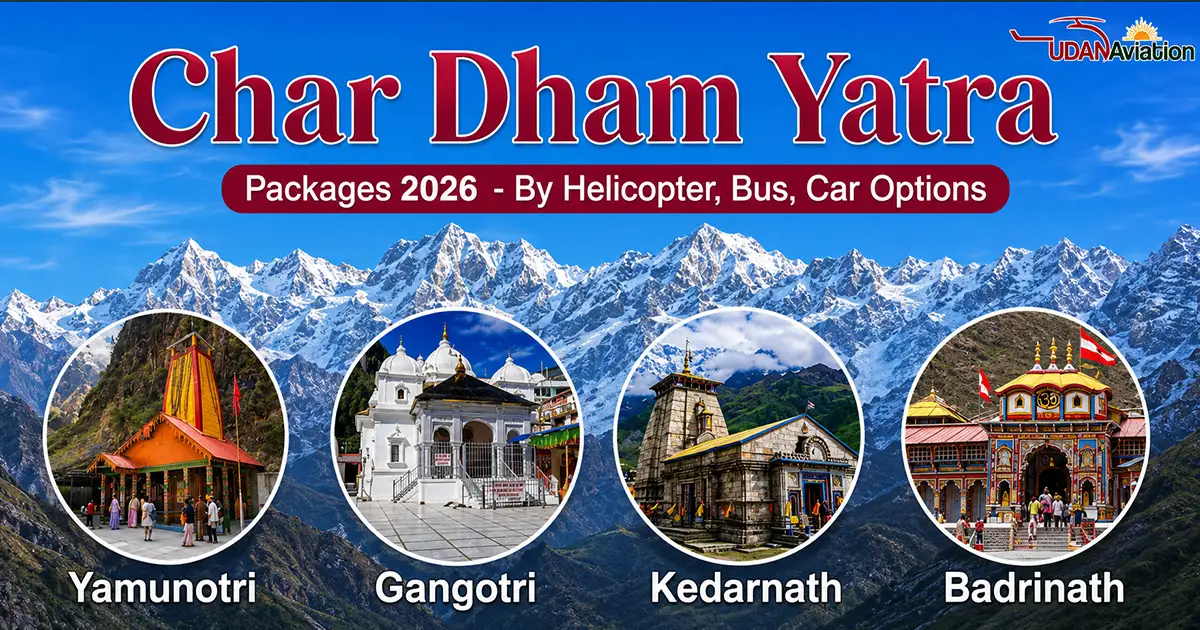
Most people who plan the Char Dham Yatra for the first time have no idea how physically demanding — and logistically complicated — it actually is. Four temples, spread across some of the most remote corners of the Garhwal Himalayas, connected by winding mountain roads that close without warning. Add altitude sickness, unpredictable weather, and peak-season crowds — and you’ll quickly understand why going with a planned package is the smarter move.
The four dhams — Yamunotri, Gangotri, Kedarnath, andBadrinath — each sit above 3,000 metres. Two of them require serious treks. Getting this yatra right takes preparation. This guide covers every package option for 2026, with accurate itineraries, real costs, and the kind of ground-level detail that actually helps.
Let us move ahead and look into the most popular tour packages and a crisp guide to embark on this sacred journey.
Char Dham Yatra Package from Delhi — 11 Days / 10 Nights
Duration: 11 Days / 10 Nights
Price: ₹25,000 – ₹45,000 per person
Route: Delhi → Haridwar → Rishikesh → Yamunotri → Uttarkashi → Gangotri → Rudraprayag → Kedarnath → Karnaprayag → Nandprayag → Vishnuprayag → Joshimath → Badrinath → Devprayag → Delhi
This is the go-to option for most devotees travelling from Delhi and the NCR region. Eleven days is a comfortable timeline — not rushed, not dragged out. Accommodation, meals, pickup, and all transport are handled. If your group has specific needs, customisation is available too.
Day-by-Day Itinerary
Day 1 — Delhi to Haridwar
Distance: ~230 km | Travel time: 5–6 hrs by road
You’ll reach Haridwar by evening. Head straight to Har Ki Pauri — the Ganga Aarti here is something else entirely. Even if you’ve seen it on video, the real thing hits differently. This is also a good time to mentally prepare for what lies ahead.
Day 2 — Haridwar to Barkot
Distance: ~210 km | Travel time: 7–8 hrs
A long mountain drive, but the views are worth it. If you want a short break, a detour through Mussoorie is possible. Barkot is a quiet hill town — rest up, you’ll need your energy for tomorrow.
Day 3 — Barkot → Yamunotri → Barkot
Drive ~36 km to Janki Chatti, then a 6 km uphill trek to Yamunotri Temple. The trek is steep in places — take your time, don’t rush it. At the top, visit Surya Kund (the natural hot spring) and Divya Shila before taking darshan. Return to Barkot the same evening.
Day 4 — Barkot to Uttarkashi
Distance: ~100 km | Travel time: 4–5 hrs
A shorter travel day. Visit the Kashi Vishwanath Temple in Uttarkashi — this ancient Shiva temple is much older than its Varanasi namesake and far less crowded. A calm, underrated stop.
Day 5 — Uttarkashi → Gangotri → Uttarkashi
Distance: ~100 km one-way | Travel time: 3–4 hrs each way
Start early. Gangotri sits at 3,415 m — you’ll feel the altitude, especially if you’ve been rushing. Take darshan at Gangotri Temple, spend some time by the Bhagirathi River, and if time permits, walk to Bhagirathi Shila. Evening Ganga Aarti here is peaceful and intimate. Return to Uttarkashi for the night.
Day 6 — Uttarkashi to Guptkashi
Distance: ~230 km | Travel time: 8–9 hrs
One of the longer driving days. The route follows the Mandakini river valley through Tehri and Rudraprayag. Keep snacks and water handy. Guptkashi is your base for Kedarnath — reach early, get settled, and sleep well.
Day 7 — Guptkashi → Kedarnath → Guptkashi
This is the big day. Drive to Sonprayag (~30 km), take the government shuttle to Gaurikund, then the 16 km uphill trek to Kedarnath. The trek is demanding — altitude, cold, and steep sections. Ponies and palki services are available if you need them. Helicopter options also exist from Phata or Sirsi helipads.
Kedarnath temple, with the snow-covered Kedarnath peak right behind it, is a sight that stays with you. Take your time. Return to Guptkashi the same day, or stay overnight at Kedarnath if needed.
Day 8 — Guptkashi to Joshimath
Distance: ~190 km | Travel time: 7–8 hrs
If time allows, a quick stop at Chopta or Ukhimath on the way is worthwhile. Joshimath is the last major town before Badrinath — stock up on anything you need here.
Day 9 — Joshimath to Badrinath
Distance: ~45 km | Travel time: ~2 hrs
An easy drive through the Alaknanda valley. Badrinath Temple, Tapt Kund (the natural hot spring — do take a dip, the water is genuinely warm), and Mana Village (the last inhabited village before the Tibet border) are all must-visits. Mana has small dhabas run by locals — the rajma chawal here is good.
Day 10 — Badrinath to Haridwar
Distance: ~320 km | Travel time: 10–12 hrs
The longest travel day of the trip. Start before sunrise. The road is scenic but tiring — breaks at Joshimath or Rudraprayag help.
Day 11 — Haridwar to Delhi
Distance: ~230 km | Travel time: 5–6 hrs
If you have time, a brief stop at Rishikesh (Lakshman Jhula area) is a nice way to close out the journey. Back in Delhi by afternoon.
Do Dham Yatra from Delhi
If you can’t take 11 days off, or if this is your first mountain yatra and you want to start smaller — the Do Dham package is a solid option. Two variants are available: Gangotri-Yamunotri, or Kedarnath-Badrinath. Both are 7-day trips.
Gangotri–Yamunotri Yatra — 7 Days / 6 Nights
Duration: 7 Days / 6 Nights
Price: ₹15,000 – ₹20,000 per person
Route: Delhi → Haridwar → Barkot → Yamunotri → Uttarkashi → Gangotri → Haridwar → Delhi
Day 1 — Delhi to Haridwar
Distance: ~230 km | Travel time: 5–6 hrs. Check in, rest, and attend the Ganga Aarti at Har Ki Pauri in the evening.
Day 2 — Haridwar to Barkot
Distance: ~210 km | Travel time: 7–8 hrs. Mountain roads from here on. Optional break at Mussoorie if the group wants. Overnight at Barkot.
Day 3 — Barkot → Yamunotri → Barkot
Drive to Janki Chatti (~36 km), then trek 6 km to Yamunotri. Visit Surya Kund, Divya Shila. Return to Barkot the same day.
Day 4 — Barkot to Uttarkashi
Distance: ~100 km | Travel time: 4–5 hrs. Visit Kashi Vishwanath Temple. Explore the river ghats if time permits.
Day 5 — Uttarkashi → Gangotri → Uttarkashi
One-way distance ~100 km. Early start recommended. Gangotri Temple, Bhagirathi River, optional trek to Pandava Gufa. Evening Ganga Aarti. Return overnight to Uttarkashi.
Day 6 — Uttarkashi to Haridwar
Distance: ~230 km | Travel time: 8–9 hrs. Start early. Evening in Haridwar.
Day 7 — Haridwar to Delhi
Distance: ~230 km | Travel time: 5–6 hrs. Optional Rishikesh stop on the way back.
Kedarnath–Badrinath Yatra — 7 Days / 6 Nights
Duration: 7 Days / 6 Nights
Price: ₹20,000 – ₹25,000 per person
Route: Delhi → Haridwar → Guptkashi → Kedarnath → Joshimath → Badrinath → Pipalkoti → Rishikesh → Delhi
Day 1 — Delhi to Haridwar
Travel time: 5–6 hrs. Evening Ganga Aarti at Har Ki Pauri. Overnight at Haridwar.
Day 2 — Haridwar to Guptkashi
Travel time: 8–9 hrs via Devprayag and Rudraprayag. Scenic but long — carry snacks. Overnight at Guptkashi.
Day 3 — Guptkashi → Kedarnath → Guptkashi
Drive to Sonprayag, shuttle to Gaurikund, then the 16 km trek (or helicopter from Phata/Sirsi). Darshan at Kedarnath Temple. Return to Guptkashi, or stay overnight at Kedarnath if needed.
Day 4 — Guptkashi to Joshimath
Travel time: 7–8 hrs. If you haven’t seen Chopta yet, a brief stop is worth it — the meadows here with Tungnath peak in the backdrop are stunning. Overnight at Joshimath.
Day 5 — Joshimath → Badrinath → Joshimath
Drive: ~45 km | Time: 1.5–2 hrs each way. Badrinath Temple, Tapt Kund, Mana Village. Return to Joshimath for the night.
Day 6 — Joshimath to Haridwar
Long drive: 10–11 hrs. Start early. Overnight at Haridwar.
Day 7 — Haridwar to Delhi
Travel time: 5–6 hrs. Optional Rishikesh stop on the way back.
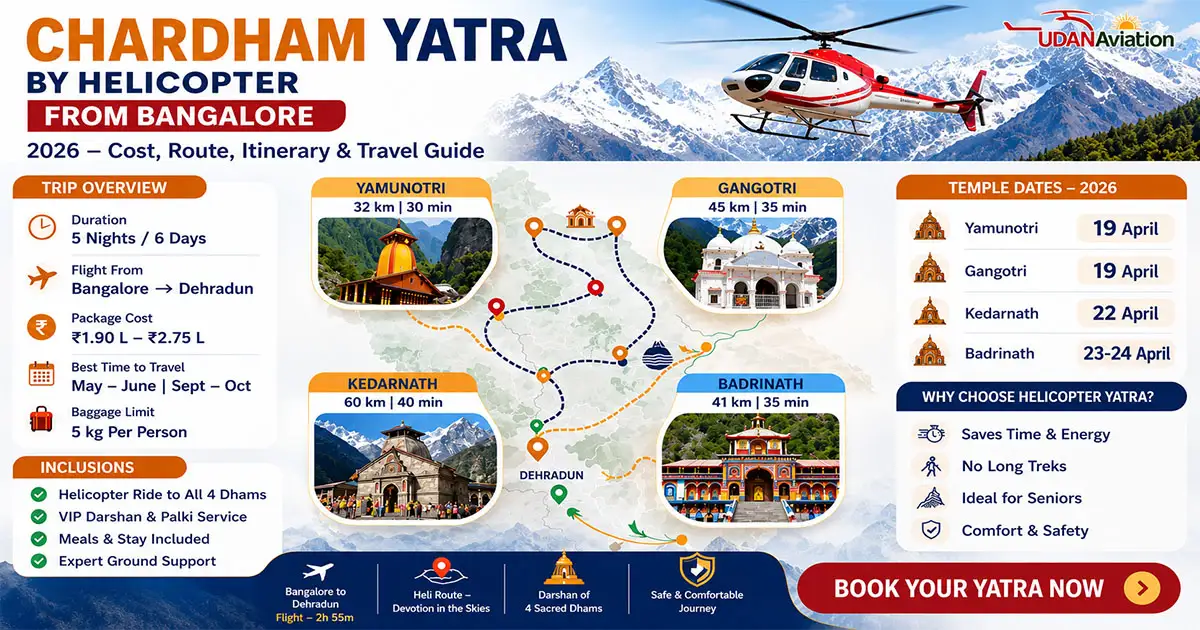
Char Dham Yatra by Helicopter — 7 Days / 6 Nights
Duration: 7 Days / 6 Nights
Price: ₹2,25,000 – ₹2,30,000 per person
Route: Dehradun → Yamunotri → Gangotri → Kedarnath → Badrinath → Dehradun
Starting Helipad: Sahastradhara Helipad, Dehradun
The helicopter package exists for a reason — and it’s not just luxury. For senior citizens, people with knee problems, heart conditions, or anyone who simply cannot do a 16 km uphill trek at 3,500 metres — this is the practical choice. You cover all four dhams, get VIP Darshan at each temple, and do it all in relative comfort. Each helicopter carries 5–6 passengers.
One thing to know: helicopter flights in the Himalayas are weather-dependent. Cancellations happen. A good operator will always have a contingency plan — either a rescheduled flight or a road alternative. Ask about this before booking.
Helicopter Yatra — Day-by-Day
Day 1 — Delhi to Dehradun
By road (~5–6 hrs) or flight (~1 hr). Hotel check-in and pre-tour briefing. This briefing matters — listen carefully, especially about what to expect at high altitude.
Day 2 — Dehradun → Yamunotri via Kharsali
Helicopter to Kharsali Helipad. From there, a pony ride or short 5–6 km trek to Yamunotri Temple. Darshan, blessings, and back to Kharsali for overnight stay.
Day 3 — Kharsali → Gangotri via Harsil
Helicopter to Harsil Helipad, then a ~22 km drive to Gangotri Temple. Darshan at the temple, time by the Bhagirathi River. Overnight at Harsil — a scenic, peaceful village rarely visited by regular tourists.
Day 4 — Harsil → Kedarnath via Phata
Fly to Phata Helipad, then shuttle to Kedarnath Helipad. Darshan at Kedarnath Temple. Overnight at Kedarnath or nearby — subject to weather and timing.
Day 5 — Kedarnath → Badrinath
Direct flight to Badrinath. Visit the temple, take a dip at Tapt Kund, and walk through Mana Village. Overnight at Badrinath.
Day 6 — Badrinath → Dehradun
Morning return helicopter to Dehradun. Rest day — your body will need it after the altitude. Optional local sightseeing in Dehradun if you’re up for it.
Day 7 — Dehradun → Delhi
Return by road or flight. End of yatra.
Do Dham Yatra by Helicopter — 5 Days / 4 Nights
Duration: 5 Days / 4 Nights
Price: ₹1,25,000 – ₹1,35,000 per person
Route: Dehradun → Kedarnath → Badrinath → Dehradun
Starting Helipad: Sahastradhara Helipad, Dehradun
Covers Kedarnath and Badrinath — the two most visited and spiritually significant dhams. Same-day Do Dham by helicopter from Haridwar is also available on request, if you’re really short on time.
Day 1 — Delhi to Dehradun
Road (~5–6 hrs) or flight (~1 hr). Hotel check-in and pre-flight briefing. Overnight at Dehradun.
Day 2 — Dehradun → Kedarnath via Phata
Early morning helicopter to Phata Helipad, then to Kedarnath. Darshan. Overnight at Kedarnath or nearby depending on weather and schedule.
Day 3 — Kedarnath → Badrinath
Morning helicopter to Badrinath. Visit the temple, Tapt Kund, and Mana Village. Overnight at Badrinath.
Day 4 — Badrinath → Dehradun
Return flight to Dehradun. Rest or local sightseeing. Overnight at Dehradun.
Day 5 — Dehradun → Delhi
Return by road or flight. Journey ends.
Why Each of the Four Dhams Matters
Badrinath
Dedicated to Lord Badrivishal (a form of Lord Vishnu), Badrinath sits on the banks of the Alaknanda River at roughly 3,300 m. It’s part of both the Chhota Char Dham circuit of Uttarakhand and the pan-India Char Dham. One of the 108 Vishnu Teerths, it’s traditionally the final stop of the yatra — and considered the most important of the four. The temple architecture is distinct Garhwali style, and the setting, ringed by high Himalayan peaks, adds to the spiritual weight of the place.
Kedarnath
At 3,583 m, Kedarnath is the highest of the four dhams. It’s one of the 12 Jyotirlingas — meaning it’s not just part of the Char Dham circuit but also among the most sacred Shiva shrines in all of India. The temple has a deep Mahabharata connection; legend holds that the Pandavas built the original shrine here to seek Shiva’s forgiveness after the Kurukshetra war. The 2013 floods destroyed much of the town around it, but the temple itself stood untouched — something that continues to be talked about by pilgrims who were there.
Gangotri
Gangotri is the origin point of the Bhagirathi River — the main tributary of the Ganga. At 3,415 m, it’s where the river emerges from the Gangotri Glacier, some 19 km upstream. The temple here is dedicated to Devi Ganga, and taking a dip in the icy Bhagirathi is considered an act of complete spiritual purification. For many pilgrims, this is the most emotionally moving stop of the four.
Yamunotri
Yamunotri, at about 3,291 m near Jankichatti, is the source of the Yamuna River and traditionally the first stop on the Char Dham circuit. The Surya Kund hot spring here is unique — devotees cook rice and potatoes in the naturally boiling water and offer it as prasad. The trek to the temple is 6 km from Janki Chatti, manageable for most people but not to be underestimated if you’re not used to altitude.
Best Time to Visit
The yatra season opens on Akshaya Tritiya (usually late April or early May) and closes around Diwali or Kartik Purnima in October–November. Outside this window, the temples are closed and the roads are often buried under snow.
| Season | Months | Conditions | Verdict |
|---|---|---|---|
| Opening Season | May – June | Clear skies, 10–15°C in the day, minimal rain | ✅ Best for first-timers — least disruption |
| Monsoon | July – August | Heavy rain, landslide risk, frequent road closures | ⚠️ Avoid if possible |
| Post-Monsoon | September – October | Crystal-clear skies, fewer crowds, cooler temps | ✅ Excellent — arguably better than May-June |
| Closing Period | November | Very cold, temples preparing to close | ⚠️ Last chance — verify closing dates first |
Char Dham Yatra Route and Distances
The full circuit covers roughly 1,300 km by road, with two major treks (Yamunotri and Kedarnath). Here’s a clear breakdown of each leg:
| Route Segment | Distance | Travel Time | Mode |
|---|---|---|---|
| Haridwar → Jankichatti | ~235 km | 10–12 hrs | Road (car/taxi) |
| Jankichatti → Yamunotri Temple | 6 km (uphill) | ~3 hrs | Trek / pony |
| Yamunotri → Gangotri Temple | ~230 km | 9–11 hrs | Road |
| Gangotri → Gaurikund | ~340 km | 14–16 hrs | Road |
| Gaurikund → Kedarnath Temple | 16 km (uphill) | 4–8 hrs | Trek / pony / helicopter |
| Kedarnath → Badrinath Temple | ~230 km | 10–12 hrs | Road |
| Badrinath Temple → Haridwar | ~310 km | 13–14 hrs | Road |
Temple-to-Temple Summary
| From | To | Distance | Approx. Time |
|---|---|---|---|
| Haridwar | Yamunotri Temple | ~245 km | 10–14 hrs |
| Yamunotri | Gangotri Temple | ~230 km | 9–11 hrs |
| Gangotri | Kedarnath Temple | ~340 km | 14–16 hrs |
| Kedarnath | Badrinath Temple | ~230 km | 10–12 hrs |
| Badrinath | Haridwar | ~310 km | 11–14 hrs |
What to Pack — and What to Leave Behind
Keep the bag light. Seriously. You’ll be loading and unloading it across 10+ days, and on the treks — every extra kilo is felt. Here’s what genuinely matters:
- Warm clothing: Thermal inners, fleece or woolen jacket, windproof outer layer, woolen cap, gloves, scarf, thick socks. Even in May it can drop to near zero at night near Kedarnath and Badrinath.
- Footwear: Waterproof trekking shoes or boots — not sports sneakers. Your feet will be on wet, uneven mountain paths.
- Documents: Government-issued ID card (Aadhaar/Passport), printed Yatra Pass, Medical Certificate if your doctor has given one, Driving License if self-driving any section.
- Medicines: First aid kit, Diamox or AMS tablets (consult your doctor before carrying), anti-nausea tablets, paracetamol, cold/cough medicine, ORS sachets, antacids. Don’t buy these on the road — bring everything from home.
- Rain gear: Compact rain poncho, waterproof cover for your bag, trekking pole (especially helpful on the Kedarnath route).
- Sun protection: SPF 50+ sunscreen and UV-protection sunglasses — UV intensity at altitude is much higher than in the plains. Sunburn and snow blindness are real risks people underestimate.
- Snacks: Dry fruits, salted nuts, glucose biscuits, energy bars. Mountain dhabas exist but aren’t always reliable on timing.
- Extras: Reusable water bottle, small headlamp (for pre-dawn treks), power bank.
Safety — The Stuff Worth Knowing
Nobody talks about this enough in package brochures, so here it is plainly:
- Don’t attempt the Kedarnath or Yamunotri treks alone. Go with the group or hire a local guide.
- Check weather before every departure. Mountain roads can close in hours during bad weather.
- If you’re on a helicopter package, get your operator’s weather cancellation and refund policy in writing before you leave Delhi.
- Drink water constantly — dehydration accelerates altitude sickness. Avoid alcohol at high altitude entirely.
- Senior citizens and anyone with a heart condition, respiratory issue, or high blood pressure should get a medical check-up specifically for high altitude before booking.
- Uttarakhand disaster helpline: 1077. Save it in your phone before you go.
How to Book
- Decide on the package — Char Dham or Do Dham, road or helicopter.
- Click Book Now or reach out to the customer care team for guidance.
- An executive will walk you through the details and help you finalise the itinerary.
- Fill in your basic information — names of travellers, travel dates, group size.
- Pay the advance amount to reserve your seats.
- You’ll receive a confirmation along with the full itinerary and pre-travel checklist.
FAQs
Q1. Do I get VIP Darshan with the package?
Ans: VIP Darshan is included with all helicopter packages. For road packages, standard darshan queues apply — though your operator may assist with queue management at busy temples.
Q2. Can elderly pilgrims do the Char Dham Yatra by helicopter?
Ans: Yes, and the helicopter package is specifically designed with them in mind. It eliminates the Kedarnath and Yamunotri treks entirely, which are the two most physically demanding sections. That said, seniors with serious heart or respiratory conditions should still get a doctor’s clearance before travelling above 3,000 m.
Q3. Where does the helicopter Yatra begin?
Ans: Sahastradhara Helipad on the outskirts of Dehradun is the starting point for all aerial Char Dham Yatra packages.
Q4. Can I reach Badrinath by train?
Ans: The closest railway station is Rishikesh, about 295 km from Badrinath. From Rishikesh, you continue by road (taxi or bus) or helicopter. There is no train service beyond Rishikesh into the mountains.
Q5. Is a same-day Do Dham Yatra possible?
Ans: Yes — same-day Kedarnath and Badrinath darshan is possible by helicopter from Haridwar or Dehradun. It’s a fast-paced option and not recommended if you want time for proper puja and darshan at each temple, but it’s available for those with limited time.
Q6. How many people fit in one helicopter?
Ans: Typically 5 to 6 passengers per helicopter, depending on the aircraft and operator. Weight limits apply — the crew will inform you at briefing.
Q7. Which is the most important temple in the Char Dham circuit?
Ans: All four are sacred and the circuit is meant to be completed as a whole. That said, Badrinath — dedicated to Lord Vishnu — is traditionally considered the presiding shrine and the final stop of the traditional Yatra sequence.
Q8. Can children visit the Char Dham temples?
Ans: Children are allowed. The temples themselves have no age restrictions. However, the altitude, cold, and trekking involved — especially at Kedarnath — require careful planning for young children. Consult your paediatrician before taking kids above 3,000 m.
Q9. Is Yatra registration mandatory in 2026?
Ans: Yes. Online registration on the Uttarakhand government portal is compulsory for all pilgrims. You need your Yatra Pass at checkpoints — no pass means no entry. Register at registrationandtouristcare.uk.gov.in as early as possible.
Q10. What happens if my helicopter gets cancelled due to bad weather?
Ans: Weather cancellations are common in the Himalayas — this isn’t rare. A reputable operator will either reschedule your flight for the next available day or arrange a road transfer as an alternative. Always ask your operator about their specific policy on this before paying. Get it in writing.